
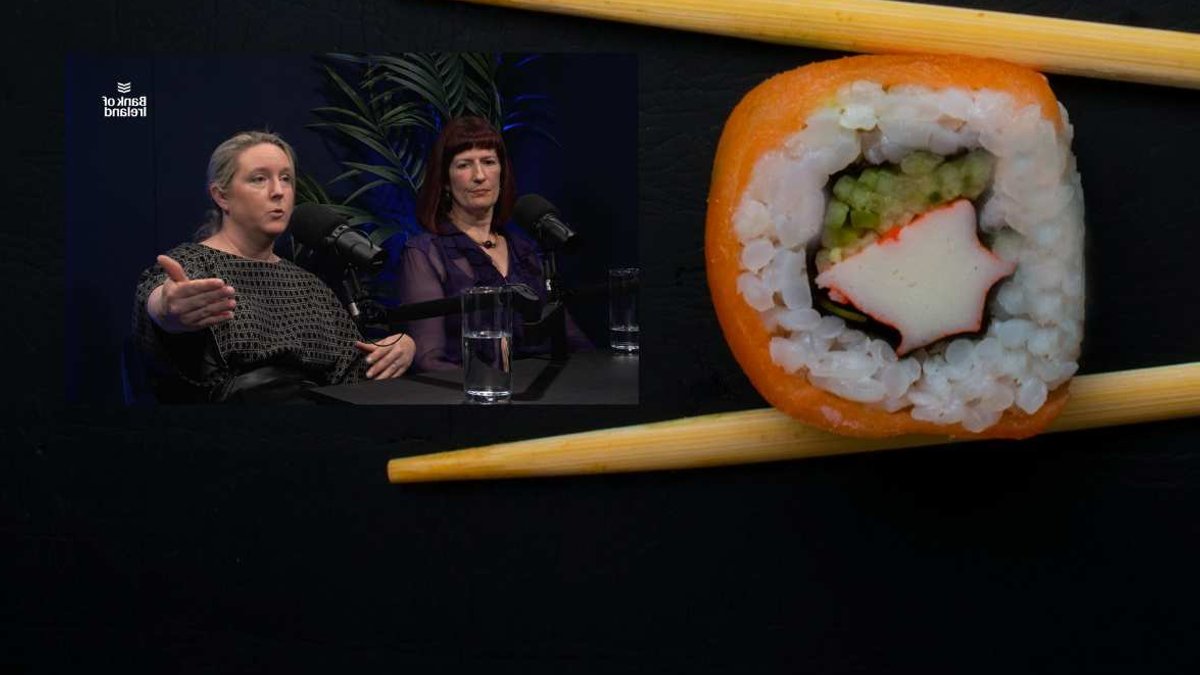
Oishii, Ireland’s leading sushi brand, grew from Ciara Troy’s modest farmers’ market stall in Greystones to a nationwide presence on supermarket shelves. Two decades later, Troy and Lucy Ryan, Bank of Ireland’s Food and Beverage Sector head, discuss the challenges of launching and sustaining a food venture.
Troy launched Oishii in 2006 with basic equipment: a Tefal rice cooker, a bamboo mat, and a handheld fan for smoothing the rice. She lacked a business plan, any financing, and a clear idea of the process. However, she did have a supplier, Stephen from Harvey Seafoods, who became her first vendor.
Nearly twenty years later, Oishii Foods supplies fresh sushi to supermarkets and service stations all over Ireland, employs 75 staff, and runs from a custom-built factory in Dublin 12. Stephen’s firm was bought by KishFish, which kept Oishii as a client. Troy still meets him every Christmas.
Troy’s journey began with a university exchange in Tokyo, where she spent a semester studying and fell in love with the local diet. “I just felt so good on the diet,” she says. “It was rice-based, so tasty and delicious. Over here at the time, there was a lot of bread, French sticks, whereas over there it was completely different.”
Troy began Oishii that same summer, producing Japanese food for farmers’ markets. She admits the name has needed two decades of patient spelling for customers. The first months were a test, with the markets providing immediate customer feedback at the lowest possible cost.
She learned quickly what customers would pay, what they returned for, and what they ignored. She sold lemon and green tea drizzle cakes, gyoza, yakitori, and miso soup—most of which she eventually dropped. Sushi continued to sell and became the core of her business.
Growing Pains and Wake Up Calls
Troy identifies a near-collision while driving her refrigerated van after a pre-dawn shift at the kitchen as her real wake-up call. “Only he honked the hell out of me,” she says of the van in her blind spot. “We would have collided. I was shaking, and I just thought, I can’t continue like this. I’m running on empty.”
She hired her first salesperson shortly afterwards, a decision that marked a pattern she has seen repeat itself throughout the business’s growth: hitting a crunch point, something giving, and the business moving to the next level.
Lucy Ryan, who spent more than 20 years working in the food industry before joining Bank of Ireland, recognises the dynamic immediately. “You have to know when you have to let go,” she says. “And that can be a bit of a challenge. You’re working all hours, and are you asking enough people at the right time for help?”
Troy’s financial education came via her brother-in-law and a simple spreadsheet. He asked her how many trays she made each week, how many hours people had worked, and what the materials cost. What was left? At seven trays per hour, Oishii was losing money. Breaking even required 15 or 16. Profitability started somewhere around 18 to 20.
The exercise led her to the Wicklow Enterprise Board, which provided financial mentoring and helped her put together a capital funding application. That, in turn, brought in Bank of Ireland, where she had held a personal account for years. Ryan points to a broader set of supports that food businesses often fail to use, including Local Enterprise Offices, county council grants, and sector bodies such as Bord Bia and Enterprise Ireland.
Access to Funding and Supports
These organisations provide a mix of mentoring, networking, and funding access that can make a material difference at an early stage. “It really is critical,” Ryan says. “Cracking the code to get some of the local grants or supports gives people a huge boost.” Troy’s approach evolved with the business, and she paid people well for the things she was weakest at, as early as she could afford to.
She built what she calls an agile team, in part because the sector demanded it. “We’re in a very dynamic sector,” she says. “It’s been up and down, in and out, and I don’t see that changing. To keep that agility and flexibility, I need my team to be agile and flexible, and in turn, I am flexible with them.” The company received an unannounced audit the day before this conversation, which Troy describes as twice-yearly events, given that sushi is classified as high-risk food.
Her response to the exposure is to build quality ownership into the entire workforce. “Quality is something that everybody needs to own,” she says. One of the more striking claims Troy makes is that Oishii has not raised its retail prices despite sustained inflationary pressure across food inputs.
The company has instead focused on internal efficiency at its Dublin 12 factory, consolidating procurement, buying in bulk where it previously could not, and streamlining processes. “I always wanted Oishii to be an affordable luxury,” she says. “Quality at an affordable price. We don’t want to be cheap. Sushi will never be cheap. We don’t want to be priced out of the market. We want it to be a regular purchase. We are built on repeat custom.”
Shifting Consumer Trends and Preferences
Ryan notes that Irish consumers are handling a genuine split in their spending, with more than half now buying private label products in supermarkets, yet they remain willing to pay a premium for fresh, convenient, high-quality food when the proposition is clear. The test is whether a product can sit credibly on both sides of that equation. Both Troy and Ryan acknowledge the sustained shift in consumer awareness, with protein being a significant trend.
Troy notes that “fibre maxing” is a term being talked about in the industry, but she is sceptical of chasing such cycles and prefers the building blocks: rice, fish, vegetables. The broader direction of travel is not in doubt, with Ryan describing a slow but visible movement away from ultra-processed food and towards cleaner labels, traceable ingredients, and more diverse flavours.
Ireland‘s food export record, which reached 19 billion euros last year, has partly been built on that reputation for quality and traceability. Troy points to demographic change as another factor reshaping demand. “The demand for authentic, ethnic, and diverse product offerings has never been greater,” she says.
A business built on introducing sushi to Irish forecourts two decades ago now looks less like an outlier and more like an early signal. Troy is disarmingly candid about her early limitations as a manager, saying she was in her twenties and could barely lead herself, let alone other people. Imposter syndrome was a regular companion.
Oishii still employs people making sushi largely by hand. Troy sees robotics as the direction of travel, not as a threat to employment but as a way of redirecting it toward higher-value roles. Ryan draws a parallel with what is already happening in produce, where robots are doing jobs, and the mushrooms tend to last longer because there is less handling.


Leave a Reply